Holtec began loading fuel into Palisades' reactor vessel August 31, moving the plant into its final pre-startup phase as it works toward becoming the first US commercial reactor to return to service after entering decommissioning.
In context: NECX 2026 closed in Dallas last week with attendees split on whether the US can actually quadruple nuclear capacity by 2050. This week's federal and utility commitments argue yes; developer stock prices still argue otherwise.
Market signal
|
▲ News hot
Holtec loads fuel at Palisades, first refueling at a US reactor once slated for decommissioning; Army signs on for a five-base microreactor build-out
|
▲▼ Market split
BWXT +1.6%, on a 6.1% run September 1
NuScale +3.1%
OKLO 5.0% lower, near its 52-week low
Centrus 8.6% lower
five sessions to September 2
|
Federal capital keeps hitting fixed schedules: fuel is already in the Palisades core, and a contractor-owned reactor program is funded for the rest of the decade. The market sorted on who collects that money rather than on the sector. BWXT is the only listed company among the five Janus winners, and it is the one that rose; the pure-play developers and the fuel names did not.
This week at a glance
-
The Army selected five microreactor developers for its
Janus Program, pairing each with a different military base under a milestone-funded, multi-year build-out
Antares Nuclear (Fort Bragg), BWXT (Fort Campbell), General Atomics (Fort Hood), Radiant Industries (Fort Benning), and Westinghouse (Fort Drum) each own and operate their own unit.
-
DOE selected
Raven-Flint Nuclear for its Nuclear Energy Launch Pad at Idaho National Laboratory, backing a fluorine-free process aimed at becoming America's second commercial uranium conversion plant
The planned Torch facility targets 500 tonnes of uranium conversion capacity a year; the NRC has separately docketed Raven-Flint's Part 40 license application.
-
Westinghouse's
eVinci microreactor completed zero-power criticality testing at a Nevada test site, validating the heat-pipe design's core physics ahead of further testing
The unit is designed for an eight-year refueling cycle; Westinghouse is also one of the five vendors selected for the Army's Janus Program.
-
MARAD signed its second port
memorandum on maritime SMRs, this time with the Port of Corpus Christi, to explore reactors for ships, microgrids, and shoreside power
The agreement adds Texas to a maritime-nuclear push that has no operating precedent in US commercial shipping.
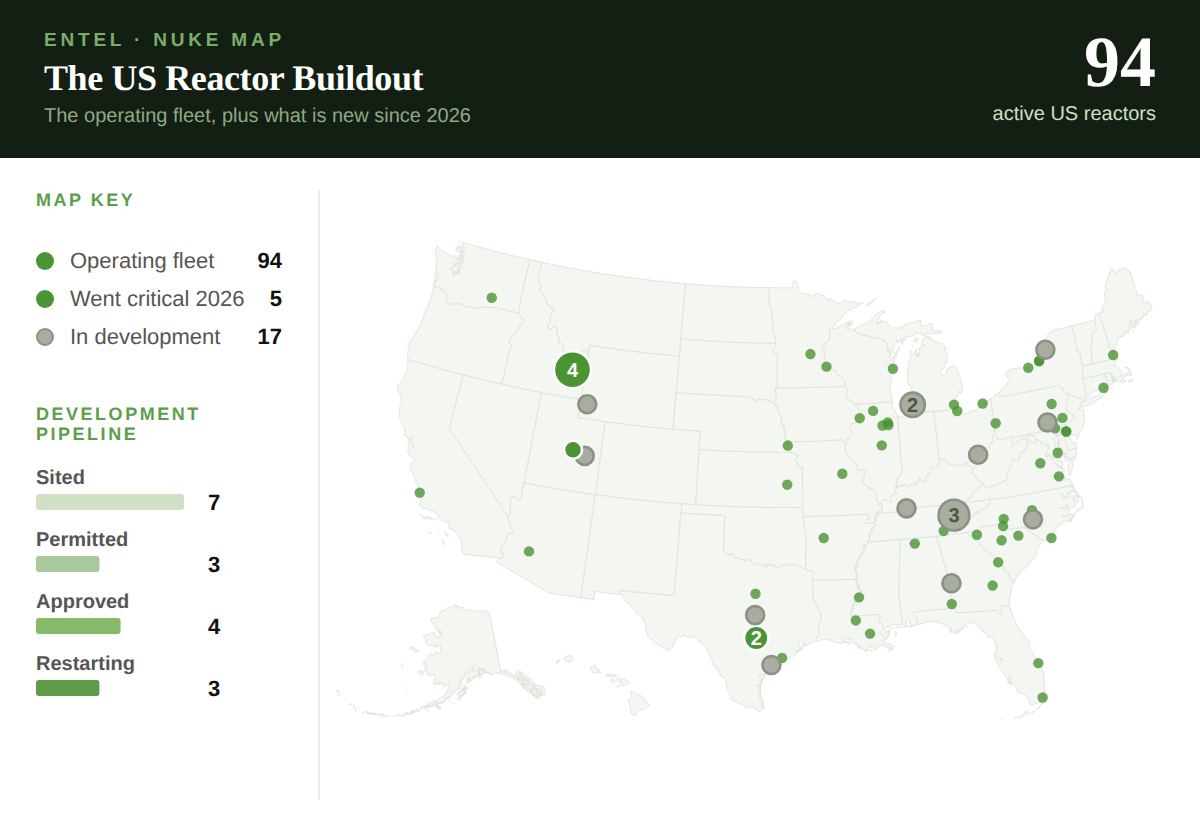
Source → live map at getentel.com/nukemap
Stat of the week
68
Years since the United States built its only uranium hexafluoride conversion plant. Metropolis Works went up in Illinois in 1958 and still has no domestic competitor, so an American utility buys conversion there or abroad, mostly from Cameco's Port Hope in Ontario. Raven-Flint's Torch, selected this week for DOE's Launch Pad at Idaho National Laboratory, is bidding to be the second American plant.
In depth
Reference: terms in this issue
Mode 6 (Refueling): NRC Technical Specifications operating mode with the reactor vessel head off and fuel loading or unloading underway; the plant cannot reach criticality in this mode.
10 CFR Part 40: NRC's licensing framework for source material (natural and depleted uranium) processing, distinct from Part 70's rules governing special nuclear material like enriched uranium.
Zero-power (cold) criticality: A demonstration that a reactor's fuel and control design sustain a chain reaction at negligible power, validating physics models before power-ascension testing begins.
Milestone-based contract: A funding structure common to DoD prototype programs, where a vendor is paid in installments only after independently verified technical goals are met.
Construction
Palisades Loads Fuel: The Final Stretch Toward America's First Reactor Restart
Before: Holtec bought the 805 MWe Palisades plant in 2022 planning to decommission it, then pivoted toward restart after securing a $1.52 billion DOE loan guarantee in September 2024. Holtec called the restart a "watershed moment" in July, but no formal restart date had been confirmed publicly; CEO Kris Singh committed only to restarting before a March 2027 power-supply contract deadline.
Now: Holtec began
loading fuel into the reactor vessel on August 31, 2026, the plant's first fuel load since it shut down in May 2022. The core takes 204 assemblies, a mix of new and partially used fuel, placing the plant in Mode 6 (refueling) under its NRC technical specifications. Chief Nuclear Officer Fadi Diya called it "an important milestone" reflecting years of restart work. Testing, inspections, and startup activities follow before Holtec can declare the plant fit for commercial operation.
→ Whether Holtec names an actual restart date once fuel loading and startup testing complete
Deal
The Army's Janus Program: $2.2 Billion for Reactors on Five Bases
Before: DOE's Reactor Pilot Program proved five advanced reactors could reach criticality this summer, at national-lab sites or their own private land, but all were demonstration-scale projects built for research and isotope production, not for powering an operational facility. No branch of the US military had committed large-scale, multi-vendor funding toward reactors that actually run a base.
Now: The Army
selected five developers on August 26, 2026, each paired with one installation: Antares Nuclear (Fort Bragg, NC), BWXT Advanced Technologies (Fort Campbell, KY), General Atomics Electromagnetic Systems (Fort Hood, TX), Radiant Industries (Fort Benning, GA), and Westinghouse Government Services (Fort Drum, NY). The Army is providing up to $2.2 billion for fiscal years 2027 through 2031, paid on a milestone basis so vendors are funded only after hitting technical objectives; more than 20 microreactors are planned across military installations. Each contractor owns and operates its reactor, with the first reactor required to run by September 30, 2028, under Executive Order 14299.
→ Which of the five reactors reaches its base first
Regulatory
Raven-Flint's Torch: A Second Try at Domestic Uranium Conversion
Before: The US has operated exactly one uranium conversion plant, Metropolis Works in Illinois, since 1958; it meets less than half of current utility demand. No second commercial-scale conversion plant had been built in the intervening decades.
Now: Raven-Flint Nuclear, an Idaho Falls startup, was
selected for DOE's Nuclear Energy Launch Pad at Idaho National Laboratory. The company said it has produced uranium hexafluoride using its Corvus Route process, which eliminates elemental fluorine gas from conversion and cuts capital costs more than 30% versus conventional methods. The NRC separately docketed Raven-Flint's 10 CFR Part 40 license application for engineering-scale operations at its Idaho Falls radiochemistry lab. The company's planned Torch facility targets 500 tonnes of uranium conversion capacity a year, enough to fuel two large power reactors.
→ Whether Torch reaches construction before the conversion bottleneck hits utility reload schedules
Global signal
Hungary
The Danube hit a record low in early August, forcing Hungary's Paks plant, nearly half the country's electricity, into its
first full shutdown in 44 years.
Units returned to normal output by late August as river levels recovered.
Question of the week
“The Army just committed $2.2 billion to put reactors on five bases by 2028, a tighter deadline than most AI data-center nuclear deals carry. Does military demand now push the industry's supply chain harder than hyperscalers, or is it still too small to matter?
Reply to this email with your take.
The open beta, October 1
The Wire is the research. The application is where that research lives: 31 projects, the stage each one sits on, and the filing that put it there. Ninety days free, no card. What we ask back is that you tell us the day a row is wrong.
Until next Thursday,
Jace Arnold
Know someone in nuclear who'd find this useful? Send it along.
Companion tool: fuel.jrand.net. Live UF6 conversion capacity, by facility.