Built for the people who sell into the US buildout.
Two markets. Suppliers chasing commercial new build, and firms chasing DOE lab and site work.
Both are trying to answer the same question, which project is real enough to bid, and both
are answering it by hand.
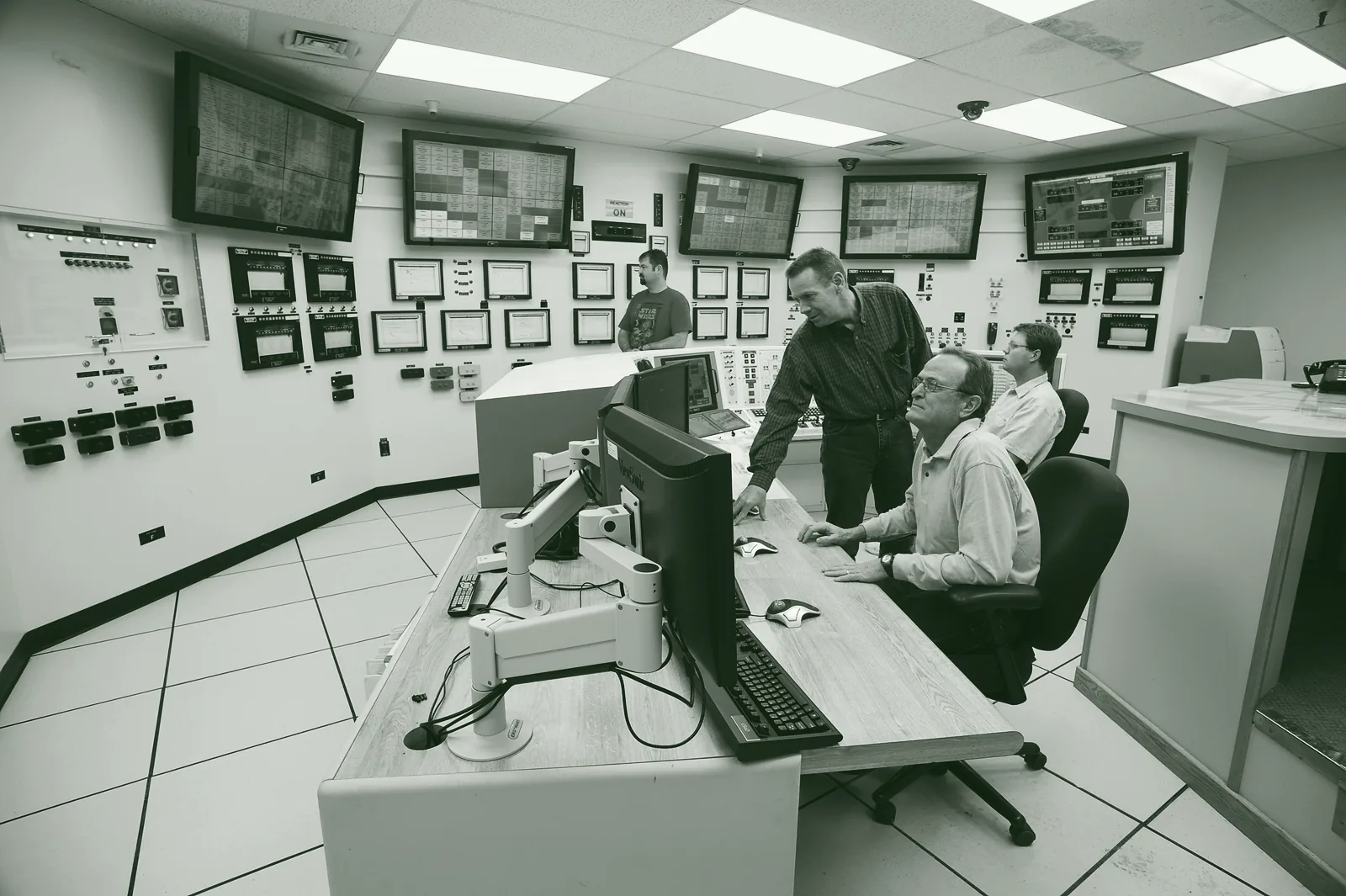
Operators train for unusual events in an exact replica of the Advanced
Test Reactor control room. 11 January 2011.
Idaho National Laboratory, CC BY 2.0.
The problem
The buildout is real and badly mapped.
No single place says which US nuclear projects are funded, which have crossed from
announcement into buying, and who signs the order. The facts exist. They are spread across
federal dockets, procurement forecasts, company disclosure and the trade press, none of
which mention each other, and none of which are written for a person trying to sell
something. So every capture desk rediscovers the same facts, separately, every quarter.
What we built
We built the complete record of the US nuclear buildout.
Every project, every buying opportunity, every business relationship,
with the document behind each one.
ENTEL reads the sources daily, matches the same company across all of them, scores what
moved against a stage ladder, and hands you the row with the document still
attached. No figure on any page is entered by hand, and anything ENTEL judged rather than
read is published as a rule you can check.
Every row on every screen links to its source document. Take the filing into your bid
review and put it on the table. If a number looks wrong, open it and tell us which one.
Opportunities
MTWTFSS
3 days2 weeks6 weeks
622 solicitations and forecasts on file, 44 of them close inside five weeks.
Market intelligence
UCOR forecast: Design, Fabrication and Testing of a large box Real-…SolicitationsOct 20
ORNL forecast: Request for Proposal: Neptune Cask Interface System…SolicitationsOct 20
Philippines advances plans for nuclear power as energy demand risesTrade pressOct 20
4,945 source documents, read and dated as they were published.
Watchlist
2,958 companies you can follow through all of it.
Read every day from federal dockets, acquisition
forecasts, award notices and company filings. Every document is hashed on arrival and
kept, so every figure here is a query against the record rather than a claim about it.
The Wire is what ENTEL publishes: breaking items read off the primary document, a weekly
issue every Thursday, and the standing instruments anyone can open, the Buying Index, the
Nuke Map and the Fuel Chain. The platform is what that reporting looks like with every
source document still attached and searchable. The Wire is how you check the work before
you pay for any of it, so it stays free permanently.
Every source runs on its own cadence and every document it returns is hashed and
archived on arrival. When a page changes under us the old version is still there, which is
the only way to answer "what did this say when you told me that." The
method page carries the counts, the cadences and the sources we have
switched off.
Grading
Every row shows the strength of its source, A to E.
Every record carries one of five evidence classes, stamped on the record itself, so the
class follows it onto every screen that cites it. A project takes the grade of its
strongest source. An NRC filing keeps its A even when ten trade stories repeat it.
A
Regulator or court document: NRC, FERC, state PUC, EIA, Federal Register, foreign regulator
B
SEC filing
C
Two independent counterparties confirming the same thing, assembled, never a raw source type
D
Single-party press release
E
Trade press or third-party reporting
Judgment
Where ENTEL makes the call.
A market segment opens on a project when its lifecycle type and current stage put it
inside a window. ENTEL works that out rather than reading it off a filing, and the rule it
used is published rather than described. Disagree with a rule and you can say exactly
where, because the rule is an object you can open.
Questions about coverage, a correction on a row, or a walkthrough of the platform against
your own pipeline. Mail goes straight to the desk that keeps the record.