Oklo received DOE startup authorization for its Groves isotope test reactor in Lockhart, Texas this week, the first advanced reactor on private land with a fully commercial supply chain to clear that gate, the same week DOE named five state finalists for integrated fuel-cycle nuclear campuses that could draw $50 billion in capital investment.
In context: The federal nuclear push is now producing compounding moves: a test reactor authorized in under 10 months from groundbreaking, a $200 million AI-nuclear program tapping Oklo and X-Energy announced last week, and a state competition for infrastructure that could co-locate enrichment, fuel fabrication, and waste management in a single location. None of it has reached developer equity prices yet, but the pipeline of federal commitments is longer than at any point since the 1970s.
Market signal
|
▲ News hot
DOE selects 5 campus finalists ($50B potential); Oklo Groves startup auth; Oklo + X-Energy $200M AI-nuclear program
|
▼ Market cold
Oklo roughly 77% below 52-week high of $193; NuScale equity more than 70% below its 52-week high
|
Federal infrastructure bets are compounding while equities lag: DOE committed to full-cycle nuclear campuses and an AI-nuclear program while uranium reached $86.60 on July 29 and Oklo at roughly $44 still trades 77 percent below its 52-week high. The market prices execution risk; the DOE calendar is pricing the build-out itself.
Sources:
Trading Economics (uranium spot, July 29, 2026), NYSE exchange data (equities)
This week at a glance
-
Oklo received DOE startup authorization for its
Groves isotope test reactor in Lockhart, Texas, clearing the way for fuel loading and first criticality
Built in approximately 10 months from groundbreaking, Groves is the first advanced reactor on private land with a supply chain sourced entirely from commercial markets. The fifth Pilot Program candidate to approach criticality is the only one that has operated fully outside the DOE site and federal-procurement system.
-
Energy Secretary Chris Wright selected five states from 28 applications. States selected will sign hosting agreements with DOE. The campuses could attract up to $50 billion in capital investment and could also host new reactors and data centers.
-
The Trump administration selected Oklo and X-Energy for a
$200 million nuclear-AI program targeting faster reactor build times for data centers, with Microsoft and Nvidia as partners
The program directs $60 million to DOE national laboratories and academic partners including the University of Texas at Austin. The initiative targets steep reductions in the time and workforce required to design, license, build, and operate reactors.
-
Czech utility ČEZ signed an MOU to add
Tušimice and Dětmarovice as two more Rolls-Royce SMR sites, bringing its fleet plan to three sites and up to six reactors totaling 3 GW
Both new sites are at former coal-fired power stations. ČEZ holds a 20 percent stake in Rolls-Royce SMR and Czech supplier Škoda JS is providing key components. The Temelín pilot remains the lead unit; the three-site program is one of the largest SMR commitments in Europe.
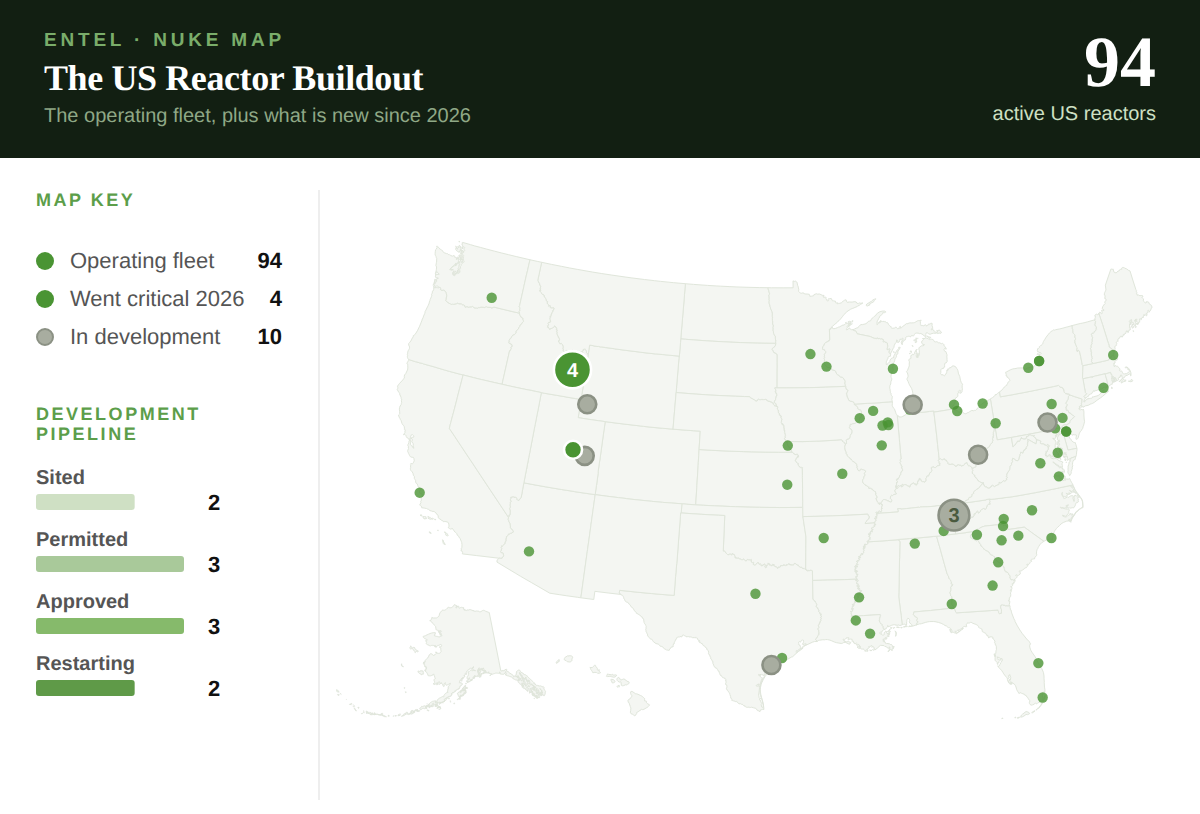
Source → live map at getentel.com/nukemap
Stat of the week
~10 months
From groundbreaking to DOE startup authorization for Oklo's Groves isotope test reactor in Lockhart, Texas, what CEO Jacob DeWitte described as "the fastest time that we are aware of to go from greenfield to substantial completion for a full-scale, privately funded and sited reactor in history." For context, the Pilot Program's four earlier criticalities ran 150 days from kickoff in the fastest case, but all operated on DOE property with federal procurement. Groves is the first to run the full clock on private land with a commercial supply chain.
In depth
Reference: new this issue
Nuclear Lifecycle Innovation Campus: A proposed DOE-state federal partnership to co-locate multiple fuel-cycle functions at a single site: enrichment, fuel fabrication, spent fuel reprocessing or recycling, separations, and waste management. DOE is selecting host states from five current contenders.
DOE startup authorization: DOE clearance that permits a reactor operating under DOE's own authority to receive nuclear fuel and begin startup testing toward first criticality. It applies to Pilot Program reactors on DOE-licensed sites or on private land under a DOE operational framework, distinct from an NRC operating license.
HALEU Availability Program: DOE's program to allocate government-owned HALEU (high-assay low-enriched uranium, the 5-20% enriched fuel most advanced reactors require) to commercial applicants through competitive rounds. The July 28 round covered NASA and Radiant; earlier rounds went to Centrus and other recipients.
Isotope test reactor: A low-power reactor designed to produce radioactive isotopes for medical, industrial, research, or national security use, rather than electricity. Oklo's Groves reactor targets isotope production; its operating experience also informs Oklo's commercial Aurora powerhouse design.
Technology
Oklo Groves: DOE Startup Authorization Clears the First Private-Land, Commercial-Supply-Chain Advanced Reactor for Fuel Loading
Before: The four reactors that achieved criticality under the DOE Reactor Pilot Program by July 4 (Antares Mark-0, Valar Ward 250, Deployable Energy's Unity, Aalo-X) all operated on DOE property, using DOE site infrastructure and, in several cases, DOE-procured fuel. The next stage of the Pilot Program question was whether a private operator could move a reactor through the DOE authorization track on its own land with a fully commercial supply chain. Oklo's Groves Isotope Test Reactor in Lockhart, Texas, broke ground on its facility and began DOE authorization in late 2025; the Preliminary and Final Documented Safety Analyses were both cleared, with final DSA approval on July 1, 2026.
Now: On July 23, 2026, Oklo
received DOE startup authorization for Groves after DOE completed a rigorous readiness review confirming the engineering, organizational, and operational readiness to safely receive fuel. The authorization permits fuel loading, startup testing, and progression toward first criticality. CEO Jacob DeWitte said the project ran from a greenfield site to startup authorization in approximately 10 months, which he described as the fastest such timeline for a privately funded, privately sited reactor. The Groves reactor is designed to produce isotopes for medical, industrial, research, and national security applications; commercial-scale isotope production experience will also inform Oklo's Aurora commercial powerhouse design. First criticality is the next milestone.
→ Whether Groves reaches criticality this summer
Construction
Nuclear Lifecycle Innovation Campuses: DOE Selects Five States to Compete for $50 Billion in Integrated Fuel-Cycle Infrastructure
Before: US domestic fuel-cycle capacity has been fragmented across single-function facilities: ConverDyn's Metropolis Works is the sole commercial UF6 conversion plant, Centrus runs the only HALEU cascade at Piketon, and Urenco USA operates enrichment in New Mexico. No site co-locates the full chain from enrichment through fabrication to waste management. DOE announced the Nuclear Lifecycle Innovation Campus concept in early 2026 and received 28 applications from 26 states by the April 1 deadline.
Now: On July 28, Energy Secretary Chris Wright
announced Idaho, Louisiana, Oklahoma, Tennessee, and Utah as the five finalist states, selected after DOE reviewed the full application field. DOE signed non-binding memorandums of understanding with each state to continue evaluating potential sites, development structures, and state and federal commitments before any hosting agreements are negotiated. The campuses are designed to co-locate fuel fabrication, enrichment, spent fuel reprocessing or recycling, separations, and radioactive waste management at a single site; campuses could also host new reactors, advanced manufacturing facilities, and data centers. DOE projects the campuses could attract up to $50 billion in capital investment, generate approximately $10 billion in state and local tax revenue, and create nearly 25,000 jobs. Selected states will sign hosting agreements with DOE at a later date.
→ Which states are selected to sign hosting agreements with DOE
Deal
$200 Million Federal Nuclear-AI Program: Oklo and X-Energy Selected to Cut Reactor Build Times for Data Centers
Before: The demand case for nuclear power at AI data centers had produced a string of power purchase agreements (PPAs), including the 20-year Microsoft-TMI deal at Crane and Google's Kairos Power contract, but no federal program specifically targeting the timeline between approved reactor design and operating plant. DOE's Advanced Reactor Demonstration Program funded early-stage reactor development and construction milestones but did not directly address the licensing speed, workforce readiness, and supply-chain steps that determine how fast a reactor moves from cleared design to producing electrons.
Now: On July 21, the Trump administration selected Oklo and X-Energy for a
$200 million program to accelerate nuclear reactor deployment for artificial intelligence data centers, with Microsoft and Nvidia participating as industry partners. The initiative directs $60 million to DOE national laboratories and academic partners, including the University of Texas at Austin. The program targets steep reductions in the time and workforce required to design, license, build, and operate reactors. DOE's stated rationale: no existing reactor-development pathway is calibrated to meet projected AI energy demand at scale. Oklo and X-Energy were selected on the strength of their respective Aurora and Xe-100 designs, both already in active DOE and NRC review channels.
→ Whether the program produces a committed timeline-to-grid target from Oklo or X-Energy
Global signal
Czech Republic
Czech utility ČEZ signed MOU for
Tušimice and Dětmarovice as two more Rolls-Royce SMR sites on July 21, bringing its plan to three sites and six reactors totaling 3 GW.
One of Europe's largest SMR commitments, at former coal-plant sites.
Question of the week
“DOE selected five states to compete for an integrated nuclear campus covering enrichment, fuel fabrication, and waste. If one gets built on schedule, which piece of the fuel cycle becomes the actual constraint on shipping advanced reactor fuel before 2030?
Reply to this email with your take.
Get this in your inbox
ENTEL ships every Thursday morning. One tight read on what moved in nuclear and why it matters.
Until next Thursday,
Jace Arnold
I'll be at the Nuclear Opportunities Workshop in Knoxville next Tuesday and Wednesday. If you're going, come find me.
Know someone in nuclear who'd find this useful? Send it along.
Companion tool: fuel.jrand.net. Live UF6 conversion capacity, by facility.