The US signed a 30-year civilian nuclear agreement with Saudi Arabia this week that would allow US firms to build a uranium enrichment facility in the kingdom if a joint study finds it warranted, without the IAEA inspection protocol the UAE accepted before Barakah.
In context: The deal lands while the US is simultaneously pressing to constrain Iran's nuclear program, a tension nonproliferation advocates were quick to name. Domestically, the picture moved in the other direction: the NRC moved the Clinch River construction permit hearing to August, four months ahead of the December estimate, and Tennessee backed X-energy's fuel campus with an $11 million state grant.
Market signal
|
▲ News hot
US-Saudi enrichment deal; Clinch River hearing moved to August; TRISO-X Tennessee fuel grant
|
▼ Market cold
Uranium flat at $85.70/lb; developer equities (Oklo, NuScale) still 70-80% below 52-week highs
|
Enrichment is the week's flashpoint: the Saudi deal opens a US services lane while Tennessee commits state money to the domestic TRISO fuel campus, but the commodity market held flat and developer equities haven't moved: uranium at $85.70 and Oklo and NuScale still deep in the red against their 52-week peaks.
This week at a glance
-
Trump approved a
US-Saudi civilian nuclear agreement that could allow Saudi Arabia to enrich uranium with US firms, without the IAEA inspection protocol the UAE accepted before Barakah
The 30-year deal departs from the so-called gold standard by potentially permitting a uranium enrichment facility in Saudi Arabia, run by US companies but without requiring the IAEA Additional Protocol. Congress has 90 days to review after formal submission.
-
The NRC set the
Clinch River mandatory hearing for August 13 in Oak Ridge, moving the BWRX-300 construction permit timeline four months ahead of the December estimate
The uncontested hearing at the Pollard Technology Conference Center is the final procedural step before the NRC commissioners vote to issue TVA's construction permit for the BWRX-300, the first advanced SMR to reach this stage in US licensing history.
-
Tennessee awarded TRISO-X, X-energy's fuel subsidiary, an
$11M state grant to expand its Oak Ridge nuclear fuel campus
The Nuclear Energy Supply Chain Investment Fund grant supports a potential second commercial TRISO facility and a dedicated R&D center. At full buildout the campus would produce enough fuel for about 55 Xe-100 reactors, roughly 4.5 GWe of advanced nuclear capacity.
-
A July heatwave forced France to
cut 6.4 GW of nuclear output as river temperatures exceeded the cooling-water discharge limits at eight reactors
Six reactors operated at reduced power and two were taken fully offline, briefly stripping roughly 14 percent of France's national electricity demand from its largest clean-energy source.
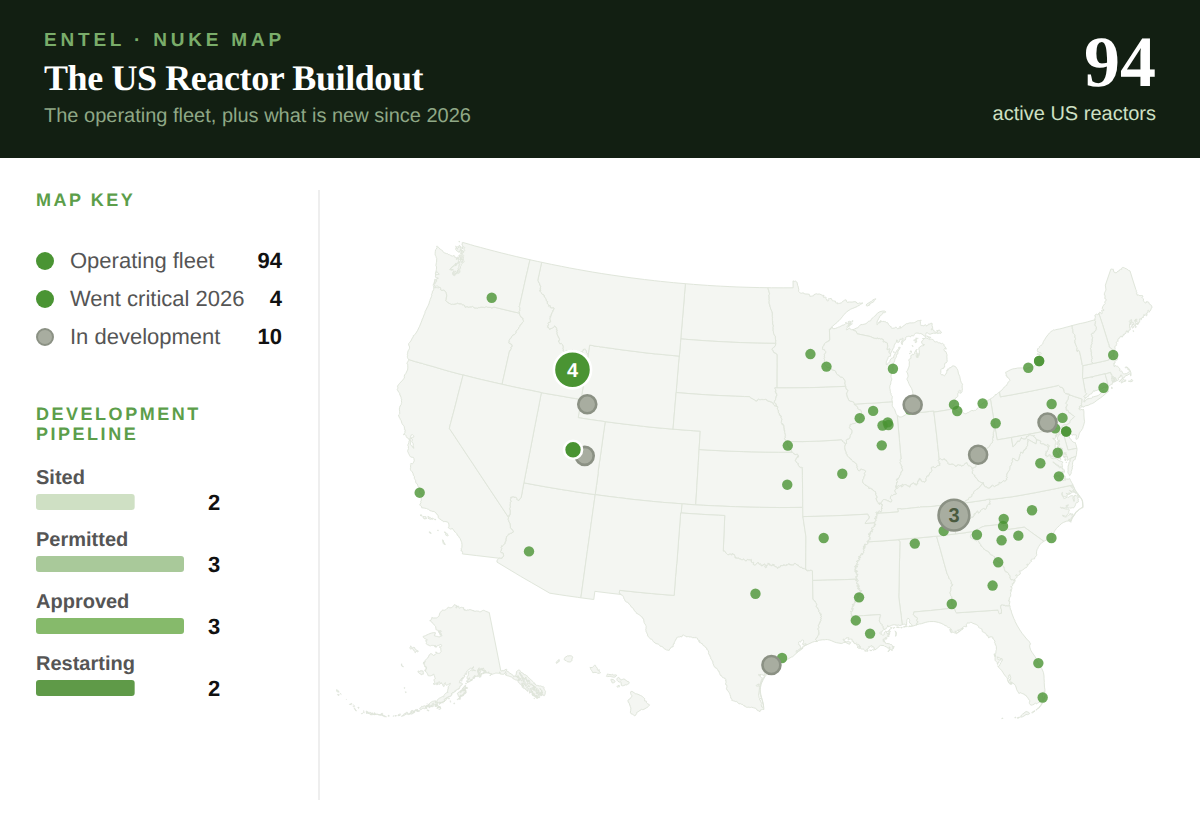
Source → live map at getentel.com/nukemap
Stat of the week
$85.70/lb
Uranium spot price on July 21, 2026, essentially flat on the week that the US announced its most consequential nuclear export agreement in decades. The Saudi deal opens a new US enrichment services lane in the Middle East and carries major implications for future fuel cycle demand, but the commodity market held steady. The spot market prices physical supply and near-term contracts; geopolitical re-alignments reach it slowly.
In depth
Reference: new this issue
123 Agreement: Named for Section 123 of the US Atomic Energy Act, this bilateral framework is required before the US can transfer civilian nuclear material, technology, or equipment to a foreign country. Congress has 90 days to review after submission and can pass a joint resolution of disapproval to block it.
IAEA Additional Protocol: An optional inspection agreement that gives IAEA inspectors broader access to declared and undeclared nuclear sites, including short-notice visits, to verify no diversion of nuclear material. The UAE accepted it as a condition of the 2009 US-UAE 123 Agreement, setting the so-called gold standard.
Mandatory uncontested hearing: An NRC procedural requirement before issuing a construction permit. Even when no formal intervenors challenge an application, the NRC must hold a public hearing at which the Atomic Safety and Licensing Board reviews the staff recommendation before commissioners vote.
TRISO fuel: Tri-structural isotropic fuel, a ceramic-coated uranium pellet design where each particle is its own containment vessel. Used in high-temperature gas-cooled reactors including X-energy's Xe-100. TRISO-X is X-energy's commercial fabrication subsidiary, located in Oak Ridge, Tennessee.
Geopolitical
US-Saudi 123 Agreement: A 30-Year Civil Nuclear Deal That Permits Enrichment Without the IAEA Additional Protocol
Before: No US civilian nuclear cooperation agreement with Saudi Arabia was in force. The gold standard for US 123 negotiations, established by the UAE's 2009 deal before Barakah, required the partner to forgo uranium enrichment and spent fuel reprocessing as a condition of access to US nuclear technology, a standard US vendors used as a differentiator against Chinese and Russian reactor competitors. Saudi Arabia had repeatedly sought a deal permitting domestic enrichment, citing economic sovereignty over its uranium reserves; Washington had held the line.
Now: President Trump approved a 30-year
US-Saudi civilian nuclear cooperation agreement on July 22, 2026. Under the deal, a joint US-Saudi team would study whether uranium enrichment is warranted and commercially viable; if so, a US firm would build and operate an enrichment facility in Saudi Arabia using US technology, but without transferring enrichment technology to Saudi hands. Critically, the agreement does not require the IAEA Additional Protocol, departing from the gold standard the UAE accepted in 2009. Congress will have 90 days to review the agreement after it is formally submitted under the Atomic Energy Act.
→ Which Middle East buyer uses Riyadh's terms as a template for its own 123 negotiation
Regulatory
Clinch River Mandatory Hearing Set for August 13: BWRX-300 Permit Timeline Moves Four Months Earlier
Before: NRC staff completed the safety evaluation recommending a construction permit for TVA's BWRX-300 at Oak Ridge and posted it to ADAMS on June 29, 2026. Issue 10 flagged December 2026 as the expected timeline for a final NRC decision, consistent with the agency's own public estimate. No hearing date had been publicly scheduled.
Now: The NRC published a
Federal Register notice scheduling the mandatory uncontested hearing for August 13, 2026, at the Pollard Technology Conference Center in Oak Ridge, Tennessee, with a public open house beginning at 5 pm. The hearing date puts the Atomic Safety and Licensing Board review, and the subsequent commissioner vote on the permit itself, on a track that could yield a final decision in the September to October timeframe, four to five months ahead of the original December estimate. The Clinch River Unit 1 BWRX-300 would be the first advanced SMR in the US to receive a construction permit.
→ The ASLB initial decision following the August 13 hearing
Deal
TRISO-X Receives $11M Tennessee Grant: Second Commercial Fuel Facility and R&D Center for Oak Ridge Campus
Before: TRISO-X's Oak Ridge campus was in active development as the only US commercial TRISO fuel fabrication facility, a single-source constraint for X-energy's Xe-100 reactor pipeline. The campus had no confirmed second production line, and no state-level capital commitment had been announced to accelerate expansion.
Now: The State of Tennessee awarded TRISO-X an
$11 million economic development grant on July 15 through the Nuclear Energy Supply Chain Investment Fund established by Governor Bill Lee. The funding supports a potential second commercial fuel facility and a dedicated R&D center. At full buildout, the campus is designed to produce enough TRISO-X fuel for approximately 55 Xe-100 reactors, equivalent to roughly 4.5 GWe of advanced nuclear capacity and estimated to power about 3.3 million US households. The grant is expected to support over 1,000 permanent jobs.
→ The timeline for TRISO-X commercial fuel deliveries against the Long Mott and other Xe-100 construction schedules
Global signal
France
France
cut 6.4 GW of nuclear output in mid-July as a heatwave pushed river temperatures past discharge limits at eight reactors.
Climate-stressed cooling constraints are the capacity-reliability risk no reactor renewal plan has fully priced in.
Question of the week
“The US-Saudi nuclear deal could let Riyadh enrich uranium, skipping the no-enrichment pledge the UAE accepted for its reactors. Which Middle East buyer asks for the same terms next, and can US vendors still sell strict safeguards as their edge over Russia and China?
Reply to this email with your take.
Get this in your inbox
ENTEL ships every Thursday morning. One tight read on what moved in nuclear and why it matters.
Until next Thursday,
Jace Arnold
Know someone in nuclear who'd find this useful? Send it along.
Companion tool: fuel.jrand.net. Live UF6 conversion capacity, by facility.