Issue 9 wondered whether a fourth Pilot Program reactor would go critical by July 4. Four did, one more than Executive Order 14301 asked for.
In context: The deadline everyone treated as symbolic turned out to overshoot: EO 14301 asked for three advanced reactors critical outside the national labs' normal process by July 4, and DOE delivered four across 30 days. The bottleneck people assumed was technical turned out to be mostly procedural, and procedural bottlenecks move the moment someone decides they should.
Market signal
|
▲ News hot
4 criticalities, Clinch River permit, Centrus $900M
|
▼ Market cold
Oklo -22% Jun, NuScale -83% off high, NLR outflows
|
Uranium held near $85 a pound and Cameco is up on the year, a repricing of timelines rather than a broken thesis: the criticalities are physics, not cash flow, and first commercial electrons are still a 2027 story.
This week at a glance
-
The last of the large-scale restart projects are finished; the Michigan plant moves into routine maintenance, testing, and operational-readiness work before startup. The first US commercial reactor to return from decommissioning is now weeks, not years, from the grid.
-
Radiant's
Kaleidos microreactor fuel arrives at INL for full-power testing
The first TRISO fuel shipment for full-power, full-temperature testing reached the DOME facility at Idaho's National Reactor Innovation Center. Radiant moves from license to hardware behind the four pilot reactors that just went critical.
-
Cameco raises its
Cigar Lake stake to 57.4% after the TEPCO exit closes
Cameco and Orano closed their buyout of TEPCO Resources' 5% interest in the world's highest-grade uranium mine on July 2 (Cameco's share about CAD116M, roughly USD84M). Western ownership of front-end supply consolidates as HALEU and reload demand climbs.
-
June 30 drone strikes damaged the building and fire-fighting vehicles that back up Europe's largest nuclear plant, cutting the station's capacity. Second flagged strike on nuclear-site emergency infrastructure since the Barakah incident we covered in Issue 7.
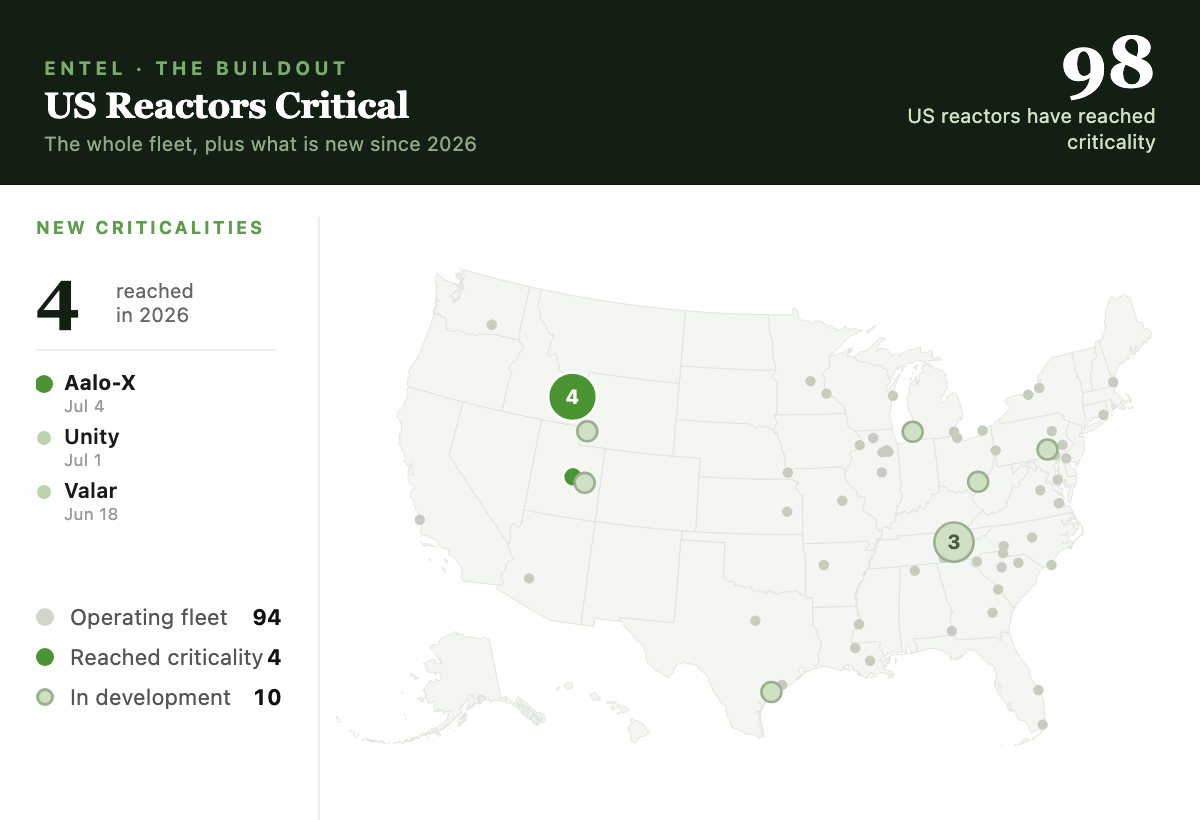
Source → live map at getentel.com/atlas
Stat of the week
~150 days
From project kickoff with Idaho National Laboratory to first criticality for Deployable Energy's Unity microreactor. For an industry that measures schedules in decades, roughly five months from a standing start to a self-sustaining chain reaction is the number that reframes what the Pilot Program actually demonstrated.
In depth
Reference: new this issue
Construction permit: NRC authorization to build a reactor, not to run it. The operating license is a separate, later application. TVA's Clinch River recommendation this week is for a construction permit only
DOE authorization track: the process under EO 14301 by which DOE approves reactor testing on its own authority, separate from NRC commercial licensing. All four Pilot Program criticalities ran on it; none is NRC-licensed
Technology
Four by the Fourth: Deployable and Aalo Close Out the Pilot Program Ahead of the Deadline
Before: Issue 8 reported Antares Mark-0 as the first private advanced reactor critical under EO 14301 (June 4, INL), and Issue 9 had Valar's Ward 250 second (June 18, Utah), with Aalo in Operational Readiness Review and Oklo queued behind. The order asked for at least three criticalities outside the national labs' normal process by July 4. Two were in. The question was whether the back half of the field would land in time, or whether the target would be met by a hair.
Now: It was met with a reactor to spare. Deployable Energy's Unity, a 1 MWe water-moderated, gas-cooled microreactor,
reached criticality on July 1 at INL, the third pilot reactor and the first under DOE's Nuclear Energy Launch Pad. Three days later Aalo's Aalo-X test reactor
went critical at 12:20 a.m. Mountain on July 4, the fourth and the first new reactor built at INL in 50 years. Energy Secretary Chris Wright confirmed the count in a July 6 statement: the order asked for three by the country's 250th birthday, and DOE authorized four. The criticalities themselves were zero-power demonstrations, though Valar has since moved past its, generating roughly 10 kW and connecting it to an Nvidia processor.
→ Which pilot reactor is first to convert a DOE authorization into an NRC commercial license, the step none of the four has taken; whether any moves from zero power to sustained operation this year; Radiant Kaleidos and Oklo Aurora-INL as the next hardware behind the lead four; whether zero-power-on-a-private-site becomes the standing pattern or the labs quietly reabsorb the work once the deadline pressure is off
Regulatory
Clinch River: NRC Staff Recommend the First US Construction Permit for a BWRX-300
Before: TVA applied in May 2025 for a construction permit to build a GE Vernova Hitachi BWRX-300 at the Clinch River site in Oak Ridge, the first US construction-permit application for that reactor and the second in North America after Ontario Power Generation's Darlington lead unit. The NRC docketed it in July 2025 and completed its supplemental environmental review in April 2026. No US small modular reactor had yet cleared the agency's safety review to a staff permit recommendation.
Now: NRC staff completed the final safety evaluation and
recommended issuing the construction permit, with the evaluation posted to the ADAMS public docket on June 29. The recommendation covers building the plant, not operating it; an operating license is a separate application down the line. The NRC expects to finish its full review by December 2026. A permit would make Clinch River the first US grid-scale SMR cleared to break ground through the commercial licensing path, the counterweight to a summer of DOE-track zero-power demos.
→ The full NRC decision expected by December 2026; whether TVA holds its build schedule and moves toward an operating-license application; Clinch River as the bellwether for the wider BWRX-300 fleet (OPG Darlington ahead of it, Elementl's Meigs County Ohio site behind it)
Deal
Centrus Signs a $900M Commercial HALEU Contract, Ending the Demonstration Phase at Piketon
Before: Issue 9 covered the Centrus-Oklo letter of intent, the first commercial HALEU offtake at gigawatt scale. But every kilogram Centrus had actually enriched at Piketon ran on DOE demonstration task orders, and that demonstration contract was set to expire June 30. The open question was whether Centrus could pivot from proving the only US HALEU cascade works to financing it at commercial volume, the enrichment step that is the real bottleneck for advanced reactors at scale.
Now: On June 30 a Centrus subsidiary signed a
$900M fixed-price contract with DOE to deploy commercial-scale HALEU enrichment capacity at Piketon, delivering one metric ton of HALEU UF
6 by March 2032, with options for up to 10 more tonnes worth $170M that lift the ceiling to about $1.07B. First new commercial capacity is expected online by 2029, adding roughly 1,000 construction jobs and 300 operating jobs in Ohio. Centrus closed out the demonstration contract in the same stretch, finishing its final 900 kg of HALEU UF
6 in mid-June, two weeks early, for more than 1,900 kg cumulative.
→ Whether the Oklo LOI and other developer offtakes convert into binding supply against this new commercial capacity; whether DOE exercises the 10-tonne option; UF6 deconversion capacity as the still-missing downstream piece of the domestic HALEU stack (tracked live at fuel.jrand.net)
Global signal
United Kingdom
Great British Energy-Nuclear
launched a £1.08bn procurement for a partner to run its SMR programme, the step from picking Rolls-Royce to actually building it.
The delivery contract is open to international firms, so US engineering majors have a live bid in front of them.
Question of the week
“Four reactors reached criticality on a DOE authorization track that never touched NRC licensing. Does that track harden into a permanent second lane for advanced reactors, stay an on-ramp every one of them still has to merge off of into Part 53, or become the pressure that finally makes NRC licensing move at the same speed?
Reply to this email with your take.
Next up
December 2026. The NRC expects to finish its full review of TVA's Clinch River construction permit application, the one its own staff just recommended approving. A permit would be the first the agency has issued for a BWRX-300 and TVA's authorization to start building the first US grid-scale SMR through the commercial path. After a summer where the headlines belonged to zero-power demonstrations on DOE's own track, this is the gate that tells us whether the licensing lane can carry a reactor all the way to a shovel.
Get this in your inbox
ENTEL ships every Thursday morning. One tight read on what moved in nuclear and why it matters.
Until next Thursday,
Jace Arnold
Know someone in nuclear who'd find this useful? Send it along.
Companion tool: fuel.jrand.net. Live UF6 conversion capacity, by facility.