The Fed's quarter-point rate hike on Wednesday makes borrowing costlier for new nuclear projects. At the same time, the NRC proposes easing reactor rules in 15 areas with a 45-day comment window.
In context: The rate hike, to a 3.75 to 4 percent range, hits reactors harder than gas or solar plants, because a reactor takes years to build and carries interest on its debt the whole time before it sells any power. Demand is there to justify the spend: EIA forecasts record US electricity sales on data center and manufacturing growth.
Market signal
|
▲ News hot
Centrus sells $500 million of shares and pre-funded warrants at $199.64 a share, with warrants for about 7 million more shares attached; Holtec markets its IPO at $15 to $18 a share
|
▼ Market cold
Cameco (CCJ) 9.2% lower to $91.21
Global X Uranium ETF (URA) 10.9% lower to $41.77
Centrus (LEU) 21.7% lower to $142.12
closes, September 9 to 15
|
Over four sessions, uranium held near $90 a pound while Cameco and the uranium ETF fell 9 to 11 percent and the S&P 500 ETF slipped less than 1 percent; Centrus's slide followed its own offering. Sprott's physical uranium trust traded at a 10.5% discount to the value of the uranium it holds, up from 6.1% a week earlier, and its holdings have sat flat since late July.
This week at a glance
-
Granted August 28, it lets Holtec build excavation support walls before a limited work authorization. Its September 8
IPO prospectus says Palisades itself is on track to restart in 2026.
-
Due no later than September 2028 under the Army's Janus Program, it would be Indiana's first power-producing reactor.
-
Assistant Secretary Theodore Garrish told a House subcommittee a "contractual methodology" follows by mid-December. The campuses would co-locate fuel-cycle work through disposal, and West Virginia is now a sixth finalist state.
-
The mandatory hearing is in Danbury, North Carolina. Duke's application picks no reactor, keeping six candidate designs in play, and no one petitioned to intervene.
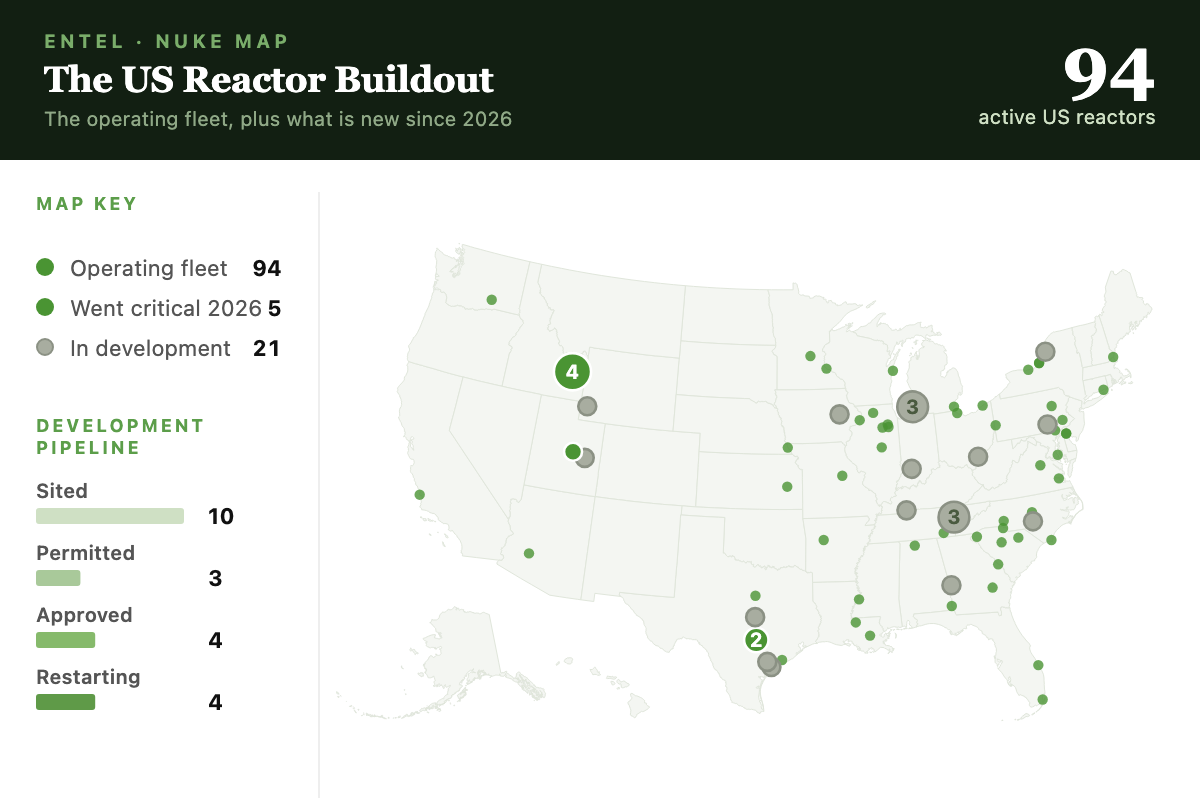
Source → live map at getentel.com/nukemap
Stat of the week
61,924
Tonnes of uranium (tU) mined worldwide in 2024, the most since 2016, according to the new Red Book, the joint OECD Nuclear Energy Agency and IAEA uranium survey. The 418 reactors operating at the start of 2025 need about 64,500 tU a year.
The world is not mining enough uranium to fuel its reactors: 2024 output ran about 2,600 tU short, and the Red Book projects requirements keep rising through 2050.
In depth
Reference: terms in this issue
Mandatory hearing: An uncontested hearing the NRC must hold before issuing certain licenses and permits, where commissioners review the staff's safety and environmental findings.
Decommissioning trust fund: Money a reactor licensee must set aside under NRC rules to pay for radiological decommissioning, removing contamination so the site's license can be terminated.
Enrichment tails: The depleted uranium left behind after enrichment, holding less U-235 than natural uranium; re-enriching it recovers usable feed.
Limited work authorization: NRC permission to start specific site work, such as foundations, before a construction permit or combined license is issued.
Regulatory
NRC Proposes Another Batch of Reactor Rule Changes
Before: Executive Order 14300, the May 2025 order directing an NRC overhaul, has the agency proposing rule changes in batches, including a July rule on reactor licensing, oversight, and siting.
Now: On September 11 the NRC released
"Regulatory Enhancements for Reactor Licensing, Decommissioning, and Operational Oversight," a 339-page proposed rule with changes in 15 areas across nine parts of its regulations. They include seismic design scaled to risk, standard design approvals that no longer expire, more flexible operator licensing, clearer Part 21 defect reporting, and wider use of decommissioning trust funds. The NRC's draft analysis projects that industry and the agency combined would save a net $311 million over 30 years at a 7% discount rate, or $411 million at 3%. The rule text sets a 45-day comment period after Federal Register publication, which is expected September 25, per
ANS Nuclear Newswire.
Watch: Which provisions draw the heaviest comment once the window opens
Construction
Blue Energy Files for a Gas-First BWRX-300 Site in Texas
Before: Blue Energy and GE Vernova announced a staged Texas plan in May: gas turbines first, GE Vernova Hitachi BWRX-300 small modular reactors after. TVA's Clinch River BWRX-300 project went through its mandatory NRC hearing August 13 and awaits a construction permit decision.
Now: Blue Energy
submitted Part 1 of a construction permit application September 15 for the first nuclear unit at the Port of Victoria, including a request to start deep foundation and shaft work early. The plan would pair two GE Vernova 7HA.02 gas turbines (about 1 GWe) with
up to five BWRX-300s (up to 1.5 GWe) to power Crusoe's proposed 1,600-acre AI campus, with gas power targeted for 2028 and nuclear by 2031. Blue Energy expects to reach a final investment decision in 2027 and to submit Part 2 of the application in the second half of that year.
Watch: Whether a 2027 investment decision holds the 2031 nuclear date
Deal
Cameco Takes All Future Output From GLE's Planned Paducah Plant
Before: Global Laser Enrichment, owned 51% by Silex and 49% by Cameco, plans a plant at Paducah, Kentucky, to re-enrich DOE-owned tails stockpiled there from decades of enrichment. GLE expects its NRC license in early 2027.
Now: This week Cameco signed an
exclusive offtake deal for all future output of the Paducah Laser Enrichment Facility, with GLE paid in line with Cameco's average realized price. It covers natural-grade UF
6 recovered from the tails plus enriched product: LEU, LEU+ (5 to 10% U-235), and HALEU (high-assay low-enriched uranium, the fuel many advanced reactor designs need). Silex's chief executive called the agreement "a key commercial pillar to support a future final investment decision."
Watch: When GLE commits to building the plant
Global signal
Thailand
Thailand's state utility EGAT signed an agreement for a
US-funded feasibility study of about 600 MWe of SMRs, covering seven US vendors' designs.
The same week in Vienna, Thai representatives spoke in support of China's new SMR network.
Question of the week
“A Texas developer filed part of an NRC permit application for small modular reactors at a site where gas turbines would power an AI data center first. Is gas-first, nuclear-later how private SMR projects get financed, or does the gas plant become permanent?
Reply to this email with your take.
The open beta, October 1
The Wire is the research. The application is where that research lives: 31 projects, the stage each one sits on, and the filing that put it there. Ninety days free, no card. What we ask back is that you tell us the day a row is wrong.
Until next Thursday,
Jace Arnold
Know someone in nuclear who'd find this useful? Send it along.
Companion tool: fuel.jrand.net. Live UF6 conversion capacity, by facility.
You're receiving a free weekly update on what's moved in nuclear.