The NRC this week proposed its first hard clock on its own environmental review process: a one-year cap on environmental assessments, a two-year ceiling on full impact statements, and the mandatory draft EIS step eliminated entirely.
In context: Last week's test reactor sprint proved the physics. This week the policy layer answered: a state mandate for new nuclear, an allied export framework signed at NATO, and the NRC opening its environmental review rules to their first fundamental rewrite.
Market signal
|
▲ News hot
NJ mandates 1,100 MW, NRC NEPA rewrite, US-Japan-Korea SMR pact
|
▼ Market cold
Oklo and NuScale still 70%+ below 52-week highs
|
July stacked up policy wins, a state mandate, a federal NEPA rewrite, an allied export pact, while developer equities barely moved: Oklo and NuScale still sit 70% below their highs. The money is favoring the fuel cycle, with uranium flat around $85 and Cameco green on the year, as the market prices execution risk on the new builds while the direction stays intact.
This week at a glance
-
Blue Energy and GE Vernova plan a first-of-its-kind
gas-plus-nuclear plant at scale, pairing BWRX-300 small modular reactors with gas turbines at a 2.5 GWe Texas site
The model compresses nuclear timelines by energizing the site with roughly 1 GWe of gas-turbine power from 2030 while the BWRX-300 licensing runs in parallel, targeting nuclear output by 2032. Final investment decision is set for 2027.
-
The public comment window for the
Crane Clean Energy Center restart closed July 8; the NRC's final environmental assessment is due in September
The final EA and finding of no significant impact will determine whether the NRC clears the first dormant US commercial reactor for restart.
-
Urenco will supply HALEU (high-assay low-enriched uranium, the fuel most advanced reactors require) from its Capenhurst facility in the UK, backed by £196 million in UK government co-investment. The deal gives Antares's Mark-0 a Western supply path independent of the Centrus Piketon cascade.
-
Newcleo files a regulatory engagement plan with the NRC for its
LFR-AS-200, a 200 MWe lead-cooled fast reactor
The July 14 pre-application engagement plan sets the framework for NRC staff review ahead of a future licensing application, adding Newcleo's lead-cooled fast reactor design to the agency's advanced-reactor docket.
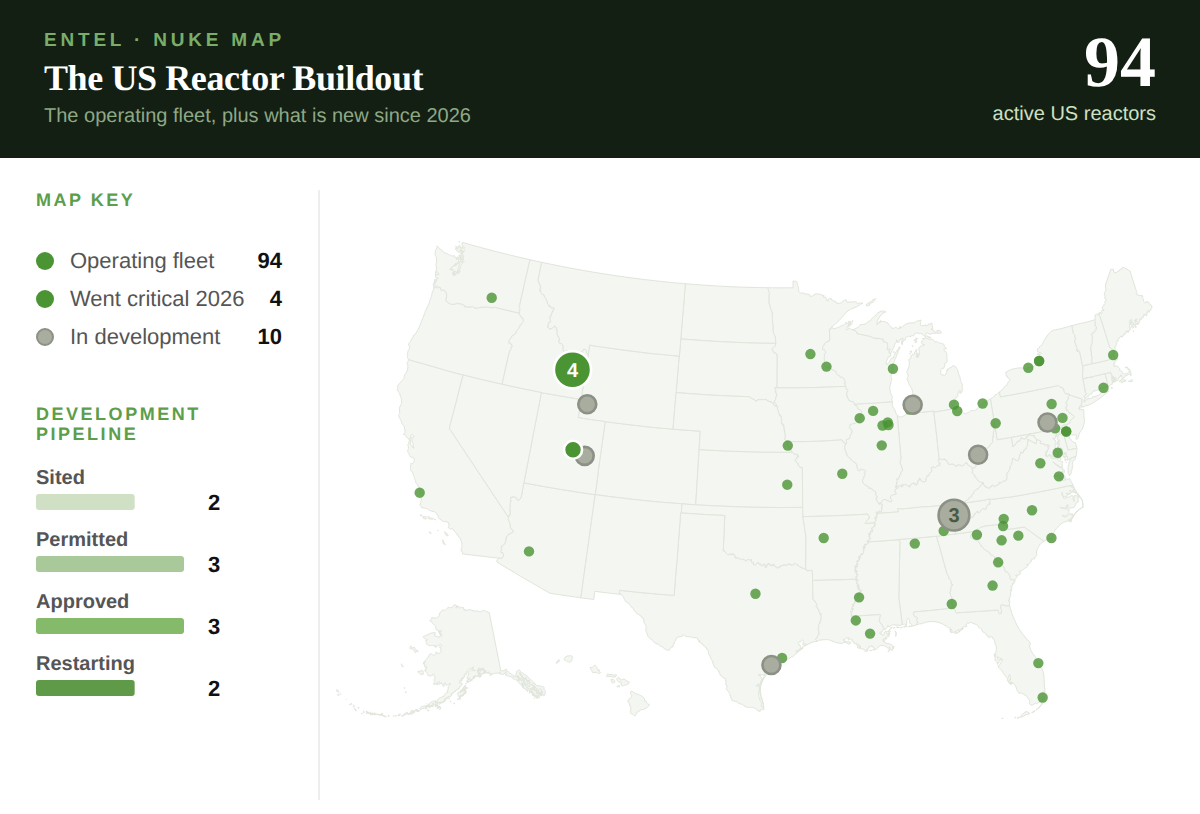
Source → live map at getentel.com/nukemap
Stat of the week
1,100 MW
The minimum new nuclear capacity New Jersey's Power NJ Act requires the state's Board of Public Utilities to procure, making New Jersey the first US state in the current nuclear build cycle to mandate new reactor procurement by law. Nuclear energy already supplies more than 40 percent of the state's electricity and more than 80 percent of its clean supply.
In depth
Reference: new this issue
Draft EIS: An environmental impact statement the NRC had long required applicants to produce for public comment before releasing the final version. NEPA never mandated this step; the NRC added it internally. The proposed Part 51 rule eliminates it.
Categorical exclusion (CatEx): A NEPA designation allowing agencies to skip full environmental review for actions determined to have no significant environmental effects. The proposed rule adds new CatEx categories covering license renewals, uprates, microreactor licensing, and advanced demonstration projects.
Memorandum of Cooperation (MOC): A government-to-government agreement that sets a shared coordination framework without the binding force of a treaty. The US-Japan-Korea SMR MOC creates the architecture for allied nuclear export coordination, not a procurement contract.
FIRST Program: The State Department's Foundational Infrastructure for Responsible Use of Small Modular Reactor Technology program, which provides bilateral technical support to partner countries developing nuclear energy capacity.
Regulatory
NRC Proposes First Hard Clock on Environmental Reviews: One Year for an EA, Two for a Full EIS
Before: The NRC's environmental review process under 10 CFR Part 51 had no statutory deadlines. A full environmental impact statement typically ran three to five or more years and required a draft EIS for public comment before the final version, a step the agency had imposed on itself for decades but that NEPA never mandated. Review scope covered non-radiological impacts such as noise, dust, and water quality even when the NRC had no authority to require mitigation. Developers planned project timelines with no reliable estimate of when the NEPA lane would clear.
Now: On July 7, the NRC published a
proposed rule to rewrite 10 CFR Part 51, adding a one-year cap on environmental assessments and a two-year cap on full environmental impact statements, eliminating the mandatory draft EIS step, narrowing review scope to impacts within the NRC's actual regulatory authority (radiological only), and creating new categorical exclusions for subsequent license renewals, power uprates, microreactor licensing, advanced demonstration projects, and site decommissioning. NRC Chairman Ho Nieh cited both EO 14300 and the Supreme Court's 2025 Seven County Infrastructure Coalition ruling. Estimated industry-wide savings: $135 million over ten years. Public comments are due August 21.
→ Whether the narrowed radiological-only scope survives comment and holds in the final rule
Geopolitical
US, Japan, and South Korea Sign Trilateral SMR Memorandum at NATO: Aligning on Indo-Pacific Reactor Exports
Before: US, Japanese, and South Korean nuclear vendors had each pitched the same Indo-Pacific markets independently, with overlapping BWRX-300 offers and no coordinated export architecture. Third-country governments choosing between Western and Chinese reactor technology (Hualong-1) faced disconnected proposals. The US State Department's FIRST Program operated bilaterally and had no allied framework behind it.
Now: At the NATO Summit in Ankara on July 7, Secretary of State Marco Rubio, Japanese Foreign Minister Motegi Toshimitsu, and South Korean Foreign Minister Cho Hyun
signed a Memorandum of Cooperation on SMR deployment in third countries, with an initial focus on the Indo-Pacific. The MOC commits to fleet deployment models that de-risk project development, achieve economies of scale, harmonize licensing processes, and optimize supply chains across the three allied nuclear industries. The US committed over $10 million in new FIRST Program funding for Indo-Pacific technical support and established an SMR Regional Training Hub for workforce development.
→ Which Indo-Pacific partner countries sign deployment commitments first under the MOC
Market
New Jersey Mandates New Nuclear: Power NJ Act Requires 1,100 MW Procurement
Before: No US state in the current nuclear renaissance had passed a law requiring a competitive procurement for entirely new nuclear capacity. New Jersey's Salem 1 and 2 and Hope Creek plants anchored the state's carbon-free electricity base. Growing AI data center load in the mid-Atlantic and bipartisan recognition of the supply gap had produced a bill that cleared both legislative chambers unanimously.
Now: Governor Mikie Sherrill
signed the Power NJ Act on July 13, making New Jersey the first US state in the current nuclear cycle to mandate procurement of new nuclear generation by law. The law requires the state's Board of Public Utilities (BPU) to issue a solicitation for at least 1,100 megawatts of new nuclear capacity within 180 days, putting the first solicitation due by approximately January 2027. Proposals must address regulatory, environmental, financial, labor, and workforce plans. Ratepayer protection provisions specify that no costs hit customers until a plant is built and supplying power and that customers bear no responsibility for cost overruns.
→ Whether the Power NJ Act's ratepayer-protection structure becomes a template for other load-growth states
Global signal
Australia + India
Australia and India
finalized a uranium export arrangement on July 9, activating a 2014 deal idle for twelve years.
It gives India, chasing 100 GW by 2047, a new Western supplier as the US and UK scale enrichment.
Question of the week
“The NRC wants to cap its own environmental reviews at two years and drop a public-comment step. If it holds, does that actually get reactors built faster, or does a lighter review just invite the lawsuits that eat the saved time back?
Reply to this email with your take.
Get this in your inbox
ENTEL ships every Thursday morning. One tight read on what moved in nuclear and why it matters.
Until next Thursday,
Jace Arnold
Know someone in nuclear who'd find this useful? Send it along.
Companion tool: fuel.jrand.net. Live UF6 conversion capacity, by facility.